
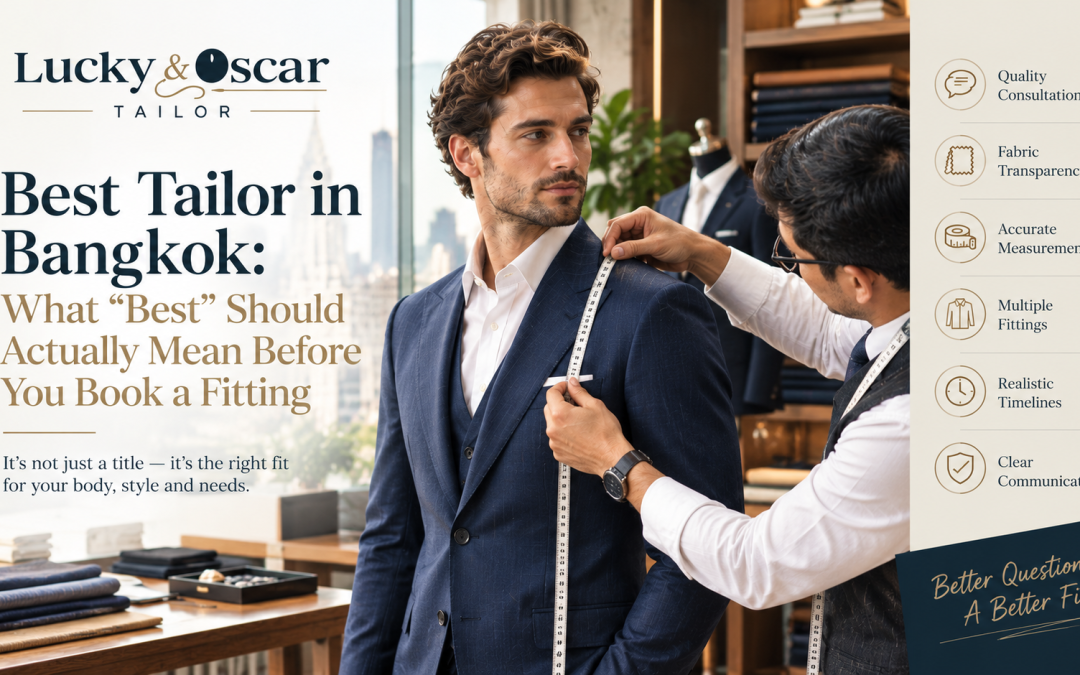
The best tailor in Bangkok is not something a search result, award badge or single five-star review can prove for every customer. “Best” should mean the tailor is suitable for your body, budget, schedule and intended garment, with a process that is transparent enough to assess before you commit. Look for careful consultation, clear fabric information, realistic fitting stages, sensible alterations, consistent communication and reviews that describe the experience in detail rather than relying on a vague ranking claim.
Quick Answer: How to Judge a Tailor
- Judge the process you can observe, not the ranking a shop gives itself.
- Ask for fibre content, weight, weave and mill, and have the exact cloth written on your order.
- Confirm how many fittings you will have and who handles alterations afterwards.
- Read detailed reviews, then send a practical question and see how clearly the shop answers.
Best Tailor in Bangkok: Use a Process-Based Definition
Start by separating marketing language from observable practice. Any tailor in Bangkok can describe itself as experienced or high quality. More useful evidence is what happens when you ask detailed questions. Does the consultant want to know where you will wear the garment? Can they explain the cloth without relying on generic phrases such as “Italian quality”? Do they discuss posture and movement rather than taking only a few circumference measurements?
A strong Bangkok tailor shop should also be comfortable explaining its own workflow. Ask when cloth is cut, what fitting stages are likely, what parts of the garment are adjustable and how final corrections are managed. A serious answer may include caveats because every order is different. Absolute promises before the tailor has seen you are less informative than a realistic plan.
Craftsmanship: Judge the Garment, Not the Vocabulary
Terms such as bespoke, custom and made to measure are used inconsistently around the world. Traditional Savile Row standards define bespoke around an individually cut pattern and substantial hand work, but Bangkok businesses may use different terminology. Our made-to-measure vs bespoke guide explains the difference in more detail. Rather than arguing over labels, ask what is physically happening to your order. Is a personal pattern created or adapted? How is the jacket structured? What fitting opportunity exists before completion?
When looking at samples, examine alignment, stitching consistency, collar shape, lapel roll (the way the lapel curves as it folds back from the chest), pocket finishing, buttonholes and the overall balance of the garment. Construction should support the cloth rather than make it stiff without purpose. A beautifully finished buttonhole cannot compensate for a collar that stands away from the neck or trousers that restrict normal movement.
Fabric Transparency Matters More Than a Huge Swatch Count
Fabric choice is useful only when the customer understands what is being offered. Ask for fibre content, weight (how heavy the cloth is), weave and mill (the factory that wove it) information where available. A hot-weather business suit might benefit from a breathable tropical wool, while a casual jacket could work in linen, cotton or a blend. The most expensive cloth in the room is not automatically the best choice for your use.
Our suits page names mills including Vitale Barberis Canonico and Drago, and our products and prices page lists different price categories for wool blend and pure wool. This is the sort of information that makes comparison easier. Still, always confirm the exact cloth and construction attached to your own quote.
Fittings, Turnaround and Alteration Policy
Bangkok is known for fast tailoring, but speed should be treated as a scheduling constraint rather than as a quality metric. A useful fitting gives the tailor time to see how the garment balances on the body and to make corrections. If you are a visitor, start the process early in your stay and leave space between fittings instead of arriving the day before departure.
Ask what happens if a correction is needed after collection. We offer alteration services, and our guide to 5 tailoring mistakes tourists make recommends allowing time for multiple fittings. The relevant question for any tailor is who will handle adjustments, when they can be done and what happens if you discover an issue after leaving Bangkok. For a step-by-step version of these questions, see our checklist for choosing a tailor in Bangkok.
Communication and Verified Reviews
Reviews are valuable when they describe specific elements: consultation quality, fitting experience, fabric choice, responsiveness and how a problem was resolved. Read a spread of recent and older reviews instead of judging a business by the headline rating alone. A long pattern of detailed feedback is more informative than a burst of short comments with little context. You can apply this test to our own TripAdvisor listing or to any other tailor you are considering.
Communication before the fitting is another test. Send one or two practical questions and note whether the response is clear. For international clients, ask about remote follow-up and reorders. For Bangkok residents, ask how future alterations are handled. The best relationship is usually one in which both sides can be precise about expectations.
Tailor Selection Checklist
| Check | What good evidence looks like |
|---|---|
| Consultation | Questions about use, comfort, style and existing fit problems |
| Measurements | Posture and body balance observed, not just basic numbers |
| Fabric | Fibre, weight, weave and source explained clearly |
| Fittings | A realistic sequence with time for corrections |
| Construction | Straight answers about internal structure and finishing |
| Aftercare | Clear alteration, delivery and reorder process |
| Reviews | Detailed feedback across different dates and customer types |
Compare the Whole Tailoring Process, Not the Headline Claim
A careful comparison should include how each shop explains fabric, records fit observations and handles corrections after a fitting. A shop’s location or its listing as a tailor shop tells you where it sits in the market, not how well its process fits your needs. Ask the same questions at each appointment, write down the answers and compare evidence rather than relying on sales language. This is especially useful when several shops make similar claims about quality or speed.
Why Choose Lucky & Oscar
We have been tailoring in Bangkok for over 20 years. Our shop is at Maitria Hotel, 26 Sukhumvit Soi 18 (Shop A), Khlong Toei, open Monday to Saturday, 11:00–19:00. You can browse our suits and shirts, read about us, and check our trunk shows if you live outside Thailand. These details do not make us objectively “the best” for every buyer, but they give you concrete information to evaluate.
A sensible next step is to use the checklist in this guide during a consultation and judge how well the advice matches your needs. To book a fitting, contact us or message us on WhatsApp at +66 81 751 1041.
Conclusion
Choosing the best tailor in Bangkok should be an evidence-based decision, not a contest of superlatives. Compare the consultation, cloth transparency, fitting plan, construction explanation, alteration process and quality of communication. A tailor who is right for a frequent business traveller may not be the same choice as one suited to a destination wedding client with a short stay. Book a conversation, ask specific questions and judge the answers against the wardrobe you actually need.
Frequently Asked Questions
How many tailors should I visit before choosing one in Bangkok?
There is no fixed number. If you have time, speaking with two or three can help you compare communication and process. Stop comparing once you have a tailor whose cloth, fit approach, timeline and service you understand and trust.
Are online reviews enough to choose a tailor?
No. Reviews are a useful screening tool, but they cannot show how a tailor will understand your body, style or schedule. Use reviews to identify candidates, then assess the consultation directly.
Is a 24-hour suit always poor quality?
Not automatically, but a very short schedule reduces the time available for meaningful fittings and corrections. Ask exactly what will happen within the timeframe rather than judging by the promise alone.
What should I ask about fabric?
Ask for fibre content, weight, weave, mill or source where available, and whether it suits your climate and wearing frequency. Also ask to see the exact cloth reference written on the order.
By Ken, Lucky & Oscar Tailor | Last updated: 16 October 2026