
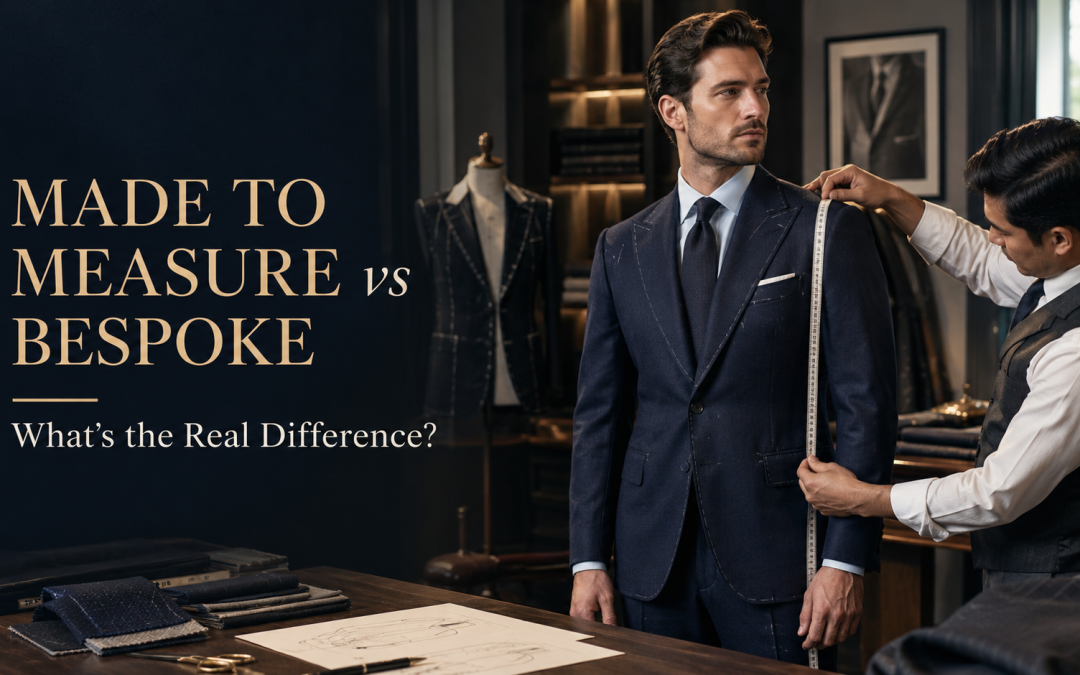
A made-to-measure suit in Bangkok usually starts from an existing base pattern that is changed to fit the customer’s measurements and chosen style. Traditional bespoke tailoring makes a new pattern just for that client and allows more fitting changes. In practice, shops use these words in different ways, so buyers should ask what the tailor really does instead of trusting the label alone. The real differences are how the pattern is made, how many fittings you get, how easily changes can be made, how the suit is built, how much you can customise, and how well the process can handle posture or uneven shoulders.
Made to measure vs bespoke: the main differences
| Area | Made to measure | Traditional bespoke |
|---|---|---|
| Pattern | An existing pattern changed to fit your measurements | A new pattern cut just for you |
| Measurements | Detailed measurements applied to a standard size | Measurements plus posture and balance used to build a unique pattern |
| Fittings | Often fewer fittings | Usually more room for fittings and pattern fixes |
| Style choices | Wide choice within the shop’s system | Very wide choice in pattern and design |
| Uneven shoulders or posture | Can be adjusted, within the limits of the system | More room to change the left and right sides separately |
| Best for | People who want a personal fit with a more standard process | People who want the most control over the pattern or a very personal process |
Why pattern creation matters
A pattern decides the shape of the garment before the cloth becomes a jacket or a pair of trousers. In made to measure, a standard pattern is changed to fit the customer’s measurements and choices. That can work very well when the starting pattern suits the client’s body. The process is more personal than ready-to-wear because length, width and balance changes are built in before the suit is made.
Traditional bespoke goes further by making a new pattern. The Savile Row Bespoke Association says its full members must cut a new paper pattern for each order, and a trained master cutter must make it. Bangkok tailors do not all follow Savile Row rules, so ask any suit tailor in Bangkok how patterns are made, kept and changed after fittings.
Measurements are not the same as fitting
Two customers can have similar chest and waist measurements but stand very differently. One may have a low right shoulder, a neck that leans forward or a rounder seat. Measurements give you numbers; a fitting shows how the cloth must hang on a real body. That is why posture checks and trial fittings matter in both good made-to-measure systems and bespoke work.
Lucky & Oscar says its tailors take dozens of measurements and body configuration observations. That is useful because it focuses on the information needed for a good fit, not on a marketing label. If your order includes a trial fitting, use it well: sit, walk, raise your arms naturally and tell the fitter where you feel pulling or too much room. If you cannot visit often, you can send your measurements online.
Customisation and construction: where the categories overlap
Both routes can offer many style choices. Lapels, pockets, vents, buttons, lining, trouser rise, pleats, cuffs and shirt details can often all be chosen. So the choices you can see do not prove that a garment is bespoke. Pattern work and how much can be changed at fittings are better ways to tell them apart. A made-to-measure system can offer many style combinations while still starting from a house pattern.
How the suit is built is a separate question. A bespoke pattern does not tell you whether a jacket is fused (glued inside), half-canvas or fully canvassed (a sewn-in inner layer), and made-to-measure suits can also be built in different ways. Ask about the inside of the jacket separately from the pattern, so you know what the price includes.
Which type of buyer may prefer each route?
Made to measure can suit clients whose bodies are fairly close to a good base pattern, who want a clear process and who value fabric and style choice without needing a lot of pattern work. It can also be practical for a business wardrobe, where several suits need to look and fit the same way. The result depends on the quality of the pattern, the fitter and how well the suit is made.
Bespoke becomes more valuable when the client has very uneven shoulders, unusual posture, a very specific shape or a wish to improve a personal pattern over time. It can also appeal to buyers who value the traditional craft itself. Neither route is automatically “better” for every person. The right choice is the one that solves your fit problem without making things harder than they need to be. Fabric matters too, so see our guide to suit fabrics for every season.
Questions that reveal the real process
- Do you make a new pattern for me, or change an existing one?
- How do you record my posture and any uneven shoulders?
- How many fittings happen before the suit is finished?
- Can the pattern itself be changed after the first fitting?
- How is the jacket built, and is that included in this price?
- How are my patterns and measurements kept for future orders?
Ask what the label means at that specific shop
These words do not mean exactly the same thing in every market, so ask the workshop to describe its process instead of relying on a name. A tailor in Bangkok may use “bespoke” or “made to measure” differently from another business. Before you buy a tailor-made suit, ask for practical details: is a new pattern made, when is the garment tried on, which building choices can be changed, and how are fixes handled after the fitting? Those answers make the comparison useful even when the words differ.
Why Choose Lucky & Oscar
Lucky & Oscar’s website uses the words custom, made to measure and bespoke, and says its tailors take dozens of measurements and body configuration observations. The suit page also offers many custom choices. For a buyer, the best step is to ask Lucky & Oscar the same questions listed above: how the pattern is made, how fitting changes are recorded and how the jacket is built. You can also read how fittings work on the tailoring process page. That keeps the talk about the garment itself, not about words that different markets use differently.
Useful Next Steps and Related Reading
Conclusion
When comparing made to measure with bespoke, do not assume that one label guarantees a certain level of quality. Ask about the starting pattern, body checks, fittings, how the suit is built and how much can be fixed. Made to measure can be excellent when a strong base pattern suits the client. Bespoke gives more control over the pattern when the body or the shape you want needs it. The real difference is the process used to make and improve the fit.
Frequently Asked Questions
Is made-to-measure better than ready-to-wear?
It is more personal because the suit is made to adjusted measurements instead of being chosen in a fixed finished size. The final quality still depends on the fitter, the pattern system, the cloth and how the suit is built.
Does bespoke always require hand sewing?
Traditional bespoke often includes a lot of hand work, but the word is used differently in different markets. Ask which steps are done by hand and how the pattern and fittings differ from the tailor’s made-to-measure service.
Can made-to-measure correct uneven shoulders?
Many systems allow some changes for uneven shoulders and posture. How much can be fixed depends on the system and the fitter. Very uneven shoulders may need a more individual pattern.
Which option is better for a first suit?
Choose based on your fit needs, budget, timing and how much personal choice you want. A good consultation should explain what each route means for your body and should not push the more expensive label automatically.
Before ordering, ask the tailor to explain the pattern and fitting process in plain words. Lucky & Oscar’s suit page is a useful starting point for the style options, and the consultation should explain how the suit is made.
By Lucky & Oscar | Bangkok Tailoring & Style Experts