
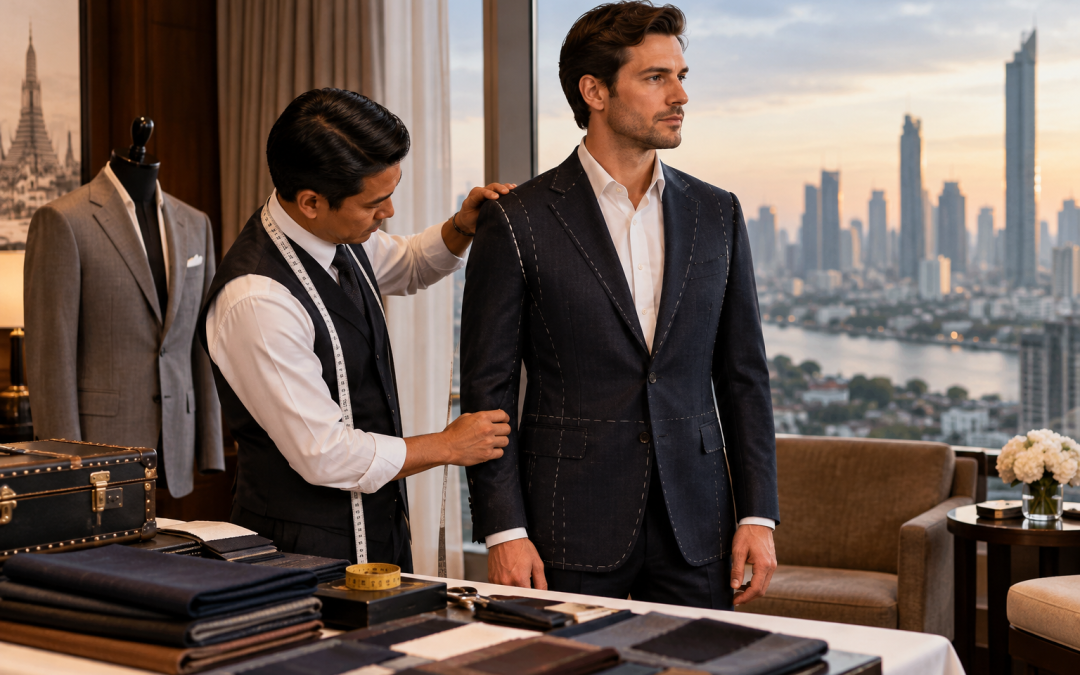
If you want to understand how a travelling tailor fitting works, the process is essentially a mobile version of a serious tailoring consultation: you book a private appointment, discuss what you need, select cloth and style details, have detailed measurements taken, then continue the fitting and adjustment process through planned follow-up communication. A good appointment should feel considered rather than rushed. The client still needs to make decisions about fit, use, fabric, construction and delivery, even when the consultation takes place away from Bangkok.
How a travelling tailor fitting works from booking to delivery
The first stage is booking. A visiting appointment is normally arranged around an announced travel schedule, with enough information exchanged beforehand to make the meeting productive. Lucky & Oscar publishes a trunk-show page for customers who cannot visit Bangkok and asks clients to enquire for travel schedules. That is the right place to confirm countries, dates and availability rather than relying on an old social post or a third-party listing.
Before the appointment, prepare a short brief. Note what garments you want, the occasions they are for, the climate in which you will wear them and any persistent fit problems you have with ready-to-wear clothing. Bringing a well-fitting jacket or shirt can be useful as a reference, but it should not replace a fresh assessment of posture, balance and proportion.
What happens during the consultation and measurement stage
At a bespoke tailor trunk show, the consultation should begin with use rather than measurements. A business traveller who wears a jacket on aircraft and in meetings needs a different cloth and silhouette from someone commissioning an evening suit. The tailor can then narrow the fabric, colour and construction choices to options that make sense for the client rather than presenting hundreds of swatches without guidance.
Measurements are only part of fitting. A skilled travelling tailor also observes shoulder slope, stance, posture, arm position and the relationship between jacket length and trouser rise. Lucky & Oscar states that its visiting service takes dozens of measurements and body-figuration observations. Those observations matter because two people with the same chest and waist can require very different pattern adjustments.
Fabric selection and style decisions without a Bangkok showroom
A mobile consultation can still offer meaningful cloth choice if the tailor carries organised bunches or swatches. Handle the cloth, fold it and look at it in natural as well as indoor light where possible. Ask about fibre content, weight, weave and intended season. For frequently travelled garments, resistance to creasing and the ability to recover shape may matter more than chasing the finest possible cloth.
Style choices should be recorded precisely. Jacket length, lapel shape, vents, pockets, trouser rise, pleats, cuffs, shirt collar and cuff design all affect the final result. A travelling tailor should also record restrained preferences such as how much shirt cuff you like to show or whether your work wardrobe needs conservative colours. Precise notes make remote follow-up much easier.
The 2026 hybrid fitting model: digital support, traditional judgement
Tailoring businesses increasingly use digital communication to support appointments, and 2026 clients are comfortable sending photographs, video, fit notes and confirmation messages after an in-person consultation. Digital measurement applications and body-scanning tools also exist in the wider apparel industry. They can help organise data or flag inconsistencies, but they do not remove the value of a trained fitter assessing balance, posture and comfort in person.
For this reason, the most sensible hybrid model treats technology as support rather than proof of fit. A photo can show a sleeve that appears long, but it may not reveal why a jacket pulls when the wearer moves. Traditional pattern work and physical fitting remain important reference points in bespoke tailoring. The Savile Row Bespoke Association, for example, defines its own bespoke standard around an individually cut paper pattern supervised by a master cutter.
Follow-up fittings, adjustments and remote communication
After the first meeting, ask what the next approval point will be. Depending on the tailor and the order, the next stage may involve an in-person fitting during the same trip, another visit later, photographs of a completed garment, or remote discussion before dispatch. Do not assume that every visiting service follows one identical sequence. What matters is knowing when you can comment and how alterations are handled.
If an adjustment is needed after delivery, describe the issue in practical terms. Explain where you feel tension, excess room or restriction, and include full-length photographs taken from the front, side and back. Avoid trying to diagnose the technical alteration yourself. A clear description such as “the collar lifts when I stand naturally” is more useful than instructing a local alterationist to remove a specific amount of cloth.
Step-by-step checklist for a successful appointment
- Confirm the official travel schedule and book a suitable appointment slot.
- Prepare a garment brief covering use, climate, dress code and fit concerns.
- Discuss cloth composition, weight, colour and care before choosing style details.
- Stand naturally during measurements and mention injuries, posture issues or comfort needs.
- Review the recorded style choices so there is no ambiguity after the meeting.
- Confirm the follow-up, adjustment, delivery and future reorder process before leaving.
Why Choose Lucky & Oscar
Lucky & Oscar is a Bangkok tailor with an established international visiting programme. Its live trunk-show information says the team travels to Europe and to the USA and Canada, while its Bangkok process is built around detailed measurements, body-figuration observations and broad fabric choice. For a client considering a remote appointment, the useful point is continuity: the same conversation about fit, cloth and intended use can begin abroad and remain connected to the tailoring work in Bangkok. Customers should still confirm the current itinerary and order-specific process directly before booking.
Useful Next Steps and Related Reading
- international trunk-show appointments
- custom tailored suits in Bangkok
- custom shirts and shirt options
- contact Lucky & Oscar about an appointment
- Trunk Shows Abroad: Where to Meet a Bangkok Tailor in Canada, Switzerland or Germany
Conclusion
Once you know how a travelling tailor fitting works, it becomes easier to judge the quality of the service before you commit. The strongest process is organised around consultation, accurate observation, documented style choices and a clear route for follow-up rather than a single measurement session. If you cannot reach Bangkok, a visiting appointment can be a practical way to start a tailored wardrobe, provided you confirm the schedule, fitting stages and adjustment arrangements in advance.
Frequently Asked Questions
What should I bring to a travelling-tailor appointment?
Bring a concise idea of what you need, examples of styles you genuinely wear, and any garment that demonstrates a fit preference or recurring problem. You do not need to arrive knowing every tailoring term.
Is a bespoke tailor trunk show only for suits?
Not necessarily. Visiting tailors may take orders for several garment types, but the available range depends on the business and trip. Confirm the garments you want when booking so the appropriate cloth and samples can be prepared.
Can a travelling tailor fit a first-time customer accurately?
An in-person first consultation allows the fitter to take measurements and observe posture directly. The quality of the result still depends on the pattern, construction, fitting process and how any later corrections are managed.
Can I reorder later without another full fitting?
Many tailoring businesses retain customer records for repeat orders, but bodies and style preferences change. Ask how long records are kept and when a fresh fitting is recommended, particularly after weight or posture changes.
If a visiting appointment suits your schedule, use Lucky & Oscar’s live trunk-show page to check the current itinerary and enquire about the fitting process for the garments you have in mind.