
If you are deciding how to choose a tailor in Bangkok, start with the process you can verify:
- Consultation quality
- Fabric transparency
- Measurements
- Fitting stages
- Realistic timing
- Alterations
- Communication
Travellers should pay particular attention to scheduling and collection time, while Bangkok residents can focus on long-term fit records, reorders and aftercare.
The aim is not to find the shop with the loudest “best” claim. It is to find a tailor who can explain what will be made, how it will be fitted and what happens if something needs changing.
Quick Answer: What to Check First
- Get the order in writing: cloth, construction, price, deposit and balance.
- Agree your final fitting day before choosing cloth, and leave time for more than one fitting.
- Ask how the garment is cut and made, and what changes at different price levels.
- Check how alterations, aftercare and your saved measurements are handled once you have left the shop.
Choosing a Tailor in Bangkok as a Traveller
A traveller has one constraint a local customer does not: departure. Start tailoring near the beginning of your stay and tell the tailor your final available fitting day before choosing cloth. Bangkok’s reputation for fast suit making can make it seem that timing is not a concern, but each fitting is an opportunity to correct balance, sleeve pitch (the angle at which the sleeve hangs from the shoulder), trouser shape or comfort. Leaving collection until the airport day removes that safety margin.
Research the tailor before you arrive. Look for a working website, an identifiable shop, recent reviews and clear contact details. Read recent reviews on Google Maps and TripAdvisor for comments about fittings and alterations, not just star ratings. On our own site, for example, you can see our Sukhumvit Soi 18 shop details, our products and prices and our trunk-show information before you book. A good tailor does not need an elaborate website, but you should be able to verify who you are dealing with and how to contact them after leaving Thailand.
How Locals Should Evaluate a Long-Term Tailoring Relationship
Bangkok residents can take a different approach. Instead of trying to order an entire wardrobe at the first fitting, consider starting with one suit, one jacket or a few shirts. Wear the garments in your real routine and note how they behave after commuting, sitting at a desk, moving between outdoor heat and air conditioning, and going through normal cleaning and care.
A relationship with a custom tailor in Bangkok improves when the tailor has feedback from real use. Perhaps you prefer slightly more room in the thigh, a higher trouser rise, a softer shirt collar or a jacket pocket position that works better with your phone. Those details can be recorded for later orders, making repeat commissions more efficient and more personal.
Look Beyond Bangkok’s 24-Hour Suit Reputation
Fast service exists in Bangkok, but “24 hours” should never be your primary selection criterion. A completed garment can be produced quickly, yet the real question is how much fitting and correction can happen inside that schedule. Our guide to 5 tailoring mistakes tourists make recommends allowing more time and notes that multiple fittings are beneficial. That is sensible guidance for any tailoring purchase.
A genuine bespoke or made-to-measure discussion should include more than a tape measure. The two terms also mean different things. Made-to-measure normally adjusts an existing base pattern to your measurements, while traditional bespoke means a pattern cut individually for you. The Savile Row Bespoke Association, for example, requires its members to make every bespoke garment from an individually cut paper pattern. Our made-to-measure vs bespoke guide explains the difference in more detail.
The fitter should consider posture, shoulder slope, balance and how you stand naturally. Ask what happens between measurements and final delivery. A transparent explanation is more valuable than a promise that the suit will be “perfect” before the first fitting has taken place.
Fabric and Construction Questions That Reveal Expertise
Ask the tailor to explain two or three cloth choices for your exact use. If you need a Bangkok office suit, the discussion might cover tropical wool, lighter construction and wrinkle recovery. For hot, humid days, linen is another option worth discussing, and our shirt fabrics guide compares cotton, linen and twill for shirts. If you need an evening suit for a cooler destination, the recommendation may differ. You should hear reasons linked to performance and formality, not only “this is premium”.
Then ask how the jacket is constructed and what changes at different price levels. You do not need to become an expert in canvas (the internal layer that gives a jacket its shape), interlinings and hand finishing, but you should understand the meaningful differences in your quote. The best tailor in Bangkok for you is one whose explanation makes the trade-offs clear enough to choose confidently.
Practical Checklist for Travellers and Locals
| Question | Traveller priority | Local priority |
|---|---|---|
| Is the shop and contact information verifiable? | High | High |
| Can the schedule allow meaningful fittings? | Critical | Medium |
| Are fabric details written on the order? | High | High |
| Are deposit, balance and receipt terms written down? | High | High |
| Is aftercare or alteration support clear? | High | Critical |
| Can measurements be retained for reorders? | Medium | Critical |
| Does the tailor understand your real dress code? | High | High |
| Can you return before final departure? | Critical | Not applicable |
Red Flags That Deserve a Second Question
- Pressure to pay before the cloth, garment and construction are clearly documented.
- A stranger, taxi driver or tuk-tuk driver steering you to a shop with a “special offer” or a sale that “ends today”; commissions are often built into the price.
- A recommendation based only on the most expensive fabric rather than your use and climate.
- Unwillingness to explain the fitting sequence or alteration process.
- A quote that changes materially without a clear change in cloth or specification.
- A suit described as “bespoke” with no explanation of pattern creation or fitting method.
- Collection scheduled so close to departure that there is no time for a final correction.
If you feel pressured or think you have been misled, Thailand’s 24-hour Tourist Police hotline is 1155; the Tourism Authority of Thailand explains how it works.
A Final Decision Test for Locals and Visitors
Before choosing, ask yourself what would make you return for a second order. A tailor worth choosing should make the process understandable enough that you know what was measured, what fabric was selected and what will happen if the fit needs refinement. A custom tailor in Bangkok is more valuable when your preferences can be discussed over time rather than reset from zero at every purchase. Locals can test this by asking how aftercare and repeat orders work; travellers should ask how communication continues after departure.
Why Choose Lucky & Oscar
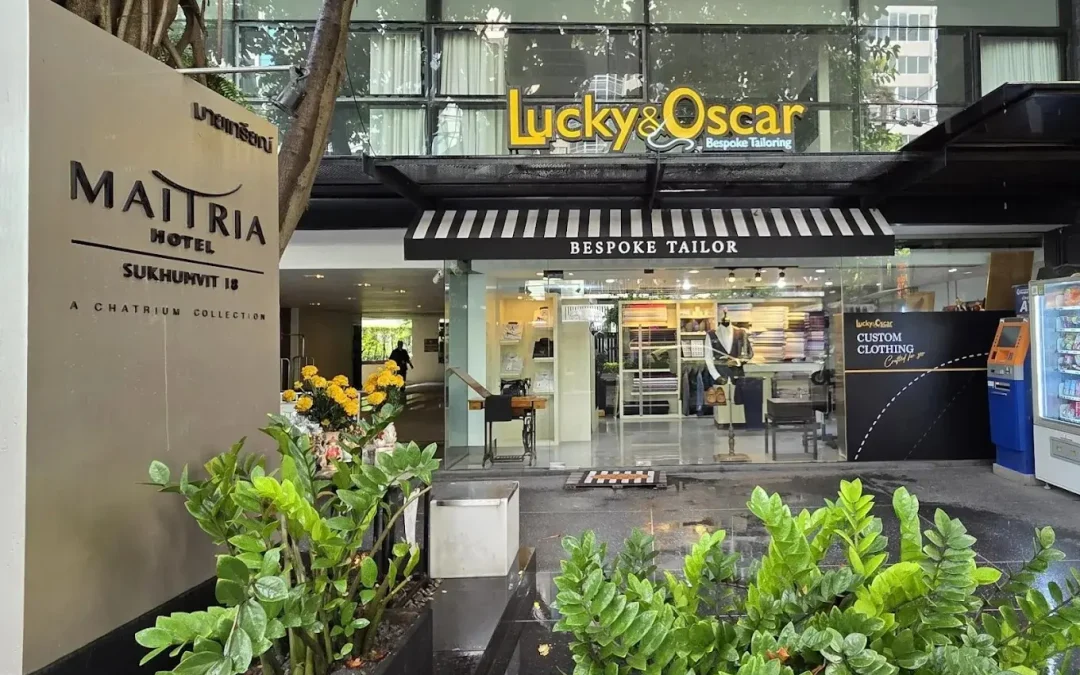
We have been tailoring in Bangkok for over 20 years. Our shop is at Maitria Hotel, 26 Sukhumvit Soi 18 (Shop A), Khlong Toei, and is open Monday to Saturday, 11:00–19:00. Before you visit, you can read about us and check our trunk shows if you live outside Thailand. We also handle alterations and can keep your measurements on file for reorders.
We would rather you judge us by the checklist above than by a self-awarded ranking. At your first consultation, ask us about the fitting sequence, the cloth record on your order and how aftercare works. To book a fitting, contact us or message us on WhatsApp at +66 81 751 1041.
Conclusion
Knowing how to choose a tailor in Bangkok is mostly about asking better questions before cloth is cut. Travellers should protect time for fittings and final corrections. Residents should look for reliable records, aftercare and a relationship that improves with feedback. In both cases, compare what the tailor actually does: how they advise, measure, document fabric, fit the garment and respond when a change is needed. That tells you more than any generic top-ten list.
Frequently Asked Questions
Should a traveller order on the first day in Bangkok?
If tailoring is a priority, starting early is sensible because it creates more room for fittings and corrections. You can still research beforehand and avoid ordering until the consultation feels right.
How do I know if fabric information is genuine?
Ask to see the selvedge (the finished edge of the cloth, which often carries the mill’s name), the bunch label (the label on the mill’s swatch book) or a written cloth reference where applicable, and have the exact fabric recorded on the order. Reputable tailors should be able to explain composition and source without becoming defensive.
Is bespoke always better than made to measure?
Not for every buyer. Bespoke can offer greater pattern and fitting flexibility, but a well-executed made-to-measure garment may suit a straightforward body shape, budget and use very well. Focus on the actual process.
Can I use a Bangkok tailor after I leave Thailand?
Many tailoring businesses support shipping or repeat orders, but the process varies. Ask how measurements are stored, how fit changes are handled and what happens if an overseas alteration is needed.
By Ken, Lucky & Oscar Tailor | Last updated: 16 October 2026